

Intergenerational child abuse: It's more complicated than “abuse begets abuse"
Worried about repeating your parents’ mistakes? What 65 studies reveal about intergenerational abuse and how most parents break the cycle

“Abuse begets abuse.” It’s one of those phrases that gets repeated so often that many people assume it means that there’s a deterministic pathway from abuse to further abuse. Hollywood certainly seems to think that’s the case.
A new meta-analysis combining 65 studies looked at what researchers call the “cycle of maltreatment.” In the broad analysis of 30 studies and 76,047 parent-child dyads, a parent’s own history of maltreatment was associated with elevated risk, but the pattern was far from deterministic.
Earlier work by the same research group found that a parent’s history of maltreatment was associated with roughly twice the risk that their child would experience maltreatment, compared with parents without such a history.
BUT,
Most parents who were maltreated as children do not go on to have children who are maltreated.
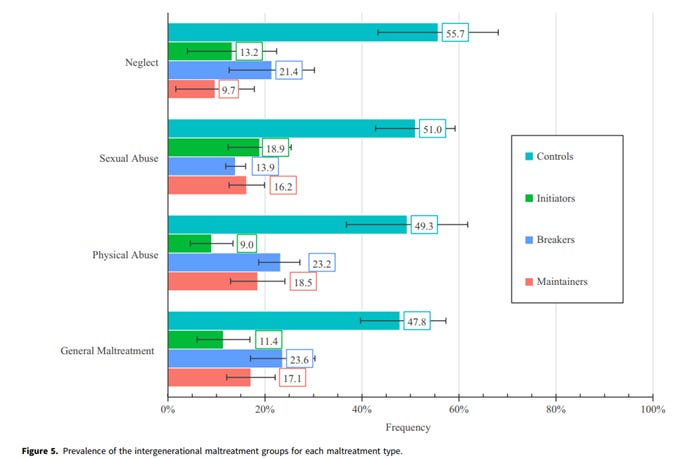
Across the studies, about 17.1% of families showed continuity of maltreatment across generations, while 23.6% were what the researchers called “cycle breakers”:
parents who had experienced maltreatment themselves, but whose children did not.
In other words, among parents with a history of maltreatment, breaking the cycle was more common than repeating it.
What can help break the cycle?
Factors like safe, stable, and nurturing relationships, including supportive relationships in childhood and healthy romantic relationships in adulthood, may help people break the cycle.
Limitations and Nuances
In this broader analysis, “continuity” did not necessarily mean the exact same type of maltreatment was repeated, and it did not always mean the parent was the direct perpetrator. The researchers included both cases in which the parent later maltreated the child and cases in which the child was maltreated by someone else, because many studies could not cleanly distinguish between them.
There was also some variation by subtype. For physical abuse and for neglect, the pattern was similar to the overall findings: breakers were more common than maintainers. However, sexual abuse showed a somewhat different pattern.
Across 17 studies, breakers were less common for sexual abuse than for maltreatment overall, while “initiators” were more common. As the authors note, one possible explanation is that parents with their own histories of adversity may have more difficulty creating relationships and environments that protect children from other perpetrators, and that risk may also be shaped by factors such as interparental violence, parental substance use, and parent psychopathology.
The Bottom Line
Discussions of intergenerational trauma can easily become overly deterministic. However, a parent’s own childhood maltreatment is only one risk factor among many, alongside mental health, relationships, social support, financial strain, and broader community conditions.
A painful childhood shapes risk. It can affect stress regulation, relationships, and parenting. But it does not seal anyone’s fate.
Perhaps one of the most hopeful findings in this literature is that, overall, breaking the cycle of violence and abuse appears to be more common than repeating it.
FAQ
If I was abused as a child, does that mean I will abuse my kids?
No. A history of maltreatment does increase risk, but the pattern is far from deterministic. In a meta‑analysis of 30 studies and 76,047 parent–child pairs, parents who were maltreated as children were about twice as likely to have a child who was maltreated, compared with parents without such a history—but most abused parents did not repeat the cycle. Across the studies, about 17.1% of families showed continuity of maltreatment across generations, while 23.6% were “cycle breakers”: parents who had been maltreated but whose children were not. In other words, among parents with a history of maltreatment, breaking the cycle was more common than repeating it.
How many abused parents actually repeat the cycle of maltreatment?
In this meta‑analysis, fewer than one in five families showed continuity of maltreatment across generations. About 17.1% of families fell into this “maintainer” group, while 23.6% were “cycle breakers,” where the parent had been maltreated but the child had not. For physical abuse and neglect, the pattern was similar: parents who broke the cycle were more common than parents who maintained it. Sexual abuse showed a somewhat different pattern, with fewer breakers and more “initiators” (cases where maltreatment appeared in the child generation without a documented history in the parent), highlighting that risks can also come from other perpetrators and broader family and community factors.
What helps break the intergenerational cycle of child abuse?
The research points to safe, stable, and nurturing relationships as key protective factors. Supportive relationships in childhood and healthy romantic relationships in adulthood may help parents regulate stress, build more secure attachments, and create environments that protect children from harm.
My spouse and I have worked very hard to break many cycles from our childhood. It’s possible and takes awareness, discipline, and empathy
So happy to hear this!!