

Misconceptions About "Kids These Days"

If we listen to public discourse and media headlines, the prevailing perception is quite bleak. The current generation is described as anxious, addicted to screens, unable to focus, impatient, and lacking resilience when dealing with the world. As parents, we are repeatedly bombarded with frightening findings regarding screen time and its effects.
Although many studies show that the effects of screens on child development are generally small, complex, and sometimes even contradictory, the internet is full of fear-mongering.
Why does this happen? Because, as one study found, sensationalist headlines using “warning” language and fear-based framing achieve much more exposure and shares, especially when wrapped in a strong scientific context.
In short, bad news is much better for the algorithm and becomes viral more easily and more often than good news. Perhaps it is time to try and change that.
An article in Scientific American listed several findings that did not receive extensive media coverage (I also looked a bit deeper into the specific papers mentioned there):
1. Increase in Delayed Gratification (The Marshmallow Test)
It is common to think that “today’s” generation, the “Screen Generation,” has no patience. It turns out that the opposite is true. An analysis of 50 years of data from the famous “Marshmallow Test” (where a child can eat one treat now or wait to receive two) shows that children today are capable of waiting longer than children in the 1960s and 1970s.
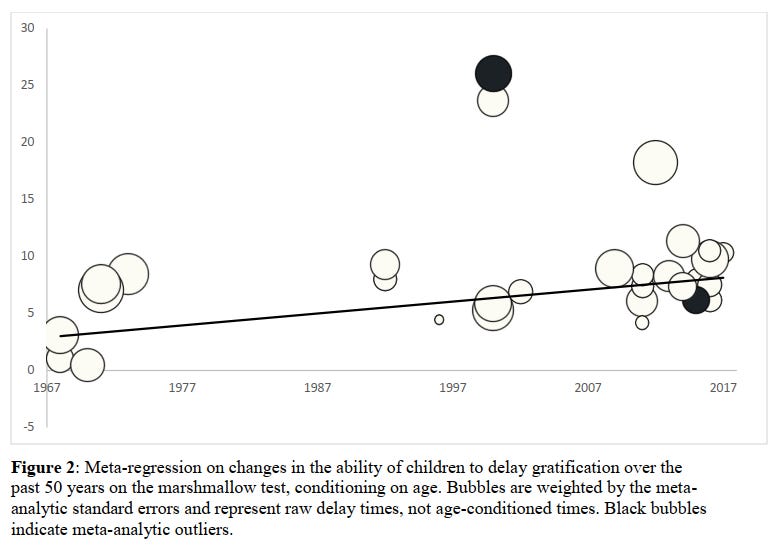
In fact, the ability to wait increased by approximately one additional minute per decade. This means that between 1967 and 2017, the amount of time children managed to wait more than doubled.
The interesting (or perhaps sad) part is that researchers surveyed 260 child development experts, and only 16% predicted there would be an increase in delayed gratification. Our memory of “how we used to be” simply misleads us.
2. Increase in Empathy and Decrease in Narcissism
You may have heard that today’s youth are selfish and less empathetic. Indeed, a famous 2011 meta-analysis that received significant media attention found a decrease in empathy between 1979 and 2009.
However, a recent study examining data up to the year 2018 revealed that there has been an increase since then. I should note that these studies are on American’s and may not generalize to other populations. But in the study they do mention that similar trend have been observed in other countries as well.
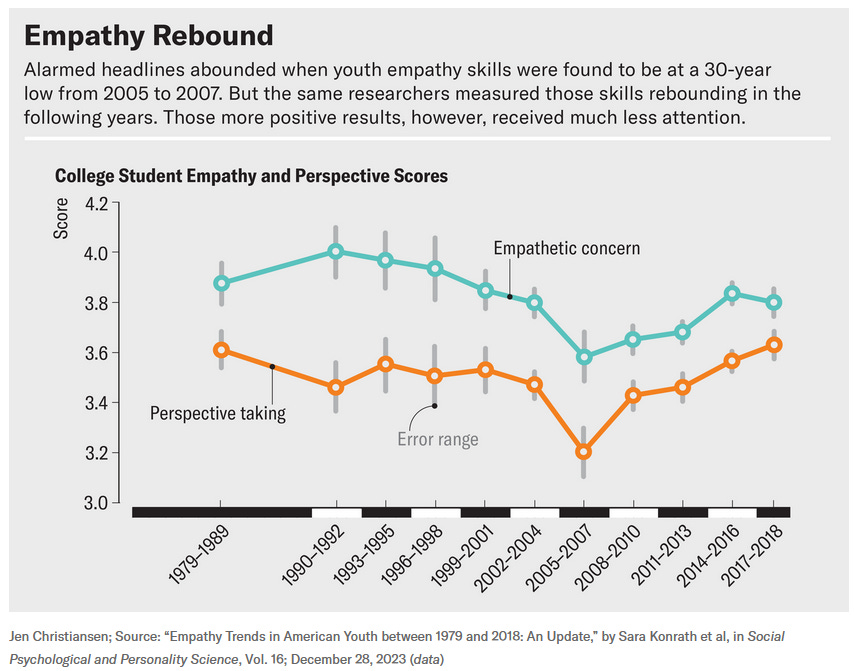
It is important to note that, as with screen studies, these effects were relatively small. This applies to both the decrease (which generated frightening headlines about the loss of empathy among teens) and the subsequent increase. We must always pay attention to effect sizes.
The research involved two specific aspects of empathy taken from a four-part index. This means there were two metrics that showed no change and two that did. Furthermore, the change found was approximately 0.4 on a scale ranging from 1 to 5. Naturally, when the results were presented, the scale was zoomed in to show only a fifth of its total range to make the changes appear significant. This is a deceptive tactic that, unfortunately, even the researchers themselves used in the article.
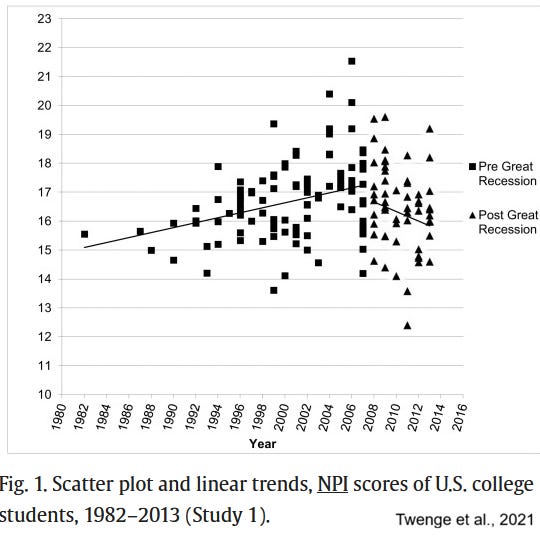
Additionally, narcissism levels, which rose until 2008, began to decline and returned to levels seen in the 1980s and 1990s.
3. Decrease in Violence and Substance Abuse
Official data shows a decline in addictive substance use among teenagers.
In 1997, approximately 82% of 12th graders in the U.S. reported drinking alcohol and 50% had tried cannabis.
By 2022, these figures dropped to 62% and 38% respectively.
Hard drug use fell from 30% to only 13%. Similarly, rates of violence and crime among adolescents have decreased significantly.
4. Better Ability to Accept Others (Tolerance and Inclusion)
The current generation displays unprecedented openness toward diversity. This seems quite obvious, but for some reason, it is discussed less often when we are busy congratulating ourselves on what a wonderful generation we were, as every generation tends to do.
For example, a study conducted among male adolescents in Canada found a significant decrease in homophobic attitudes and rigid norms of “masculinity” (such as emotional suppression and avoidance of feminine traits) between 2013 and 2019.
It should be noted that boys still use homophobic slurs (as slang or “jokes”) specifically toward their close friends. The theoretical explanation for this is that it serves as a way to maintain social hierarchy. So there’s still room for improvement…
Additionally, a large study of individuals aged 18 and older mentioned in the Scientific American article, found a consistent decline in explicit prejudice (meaning what people are willing to state consciously and out loud) regarding sexual orientation, race, skin tone, age, disability, and body weight.
However, and I mention this because it is important for us to know as parents, when implicit attitudes were tested, the results were different. While biases regarding race and sexual orientation weakened, biases toward aging and disability remained stable.
Negative stigma toward body weight actually worsened, despite repeated findings that biology and genetics play a very significant role in determining weight.
The Bottom Line
The media loves frightening headlines, especially when they involve children and screens, but it’s not supported by the data.
True, today’s children face new and unique challenges, but the data also shows another, much more optimistic side: they demonstrate more restraint, more empathy, and more open-mindedness, with much less tendency toward violence than seen in previous generations.
There is a reassuring message here for us as parents. The “softness” of modern parenting is often criticized, but it seems that the choice to explain instead of punish, and to abandon psychological control tactics (such as “I won’t speak to you until you understand what you did”), is proving successful.
But, as you know, parents have limited influence, so what else happened? The Scientific American article also mentions that these values have been introduced into schools. When the message of accepting others comes from the system and not just from parents, it becomes a part of the children’s social climate.
The success seen today is not only due to the home environment but also due to the fact that these values have integrated into other areas of life. We must fight to keep it that way.
I’m an independent researcher writing about parenting myths through the lens of science, with the goal of helping parents cut through the noise, fear, and misinformation.
If this work has been useful to you, you can support it here:
Bravo more light, less heat! In the marketing world what you describe is called, “Spreading the FUD” Fear, Uncertainty and Death. One of the most prominent and widely discussed research studies criticizing the way scientific studies are done is the 2005 paper by John Ioannidis titled "Why Most Published Research Findings Are False".